
Introduction: 5G Rollout in Pakistan and Growing Industry Concerns
The 5G rollout in Pakistan has become a major topic of discussion as the government prepares for next-generation mobile services. While policymakers highlight innovation and global competitiveness, telecom operators argue that basic issues of affordability and usability are being overlooked. Industry leaders believe that launching 5G too quickly could repeat past mistakes seen during the 4G era.
5G Rollout in Pakistan
Industry concerns, affordability challenges, and policy risks
5G Readiness
Low consumer adoption risk
Device Access
Only ~2% users own 5G phones
Market Reality
Prepaid users dominate
Key Risk
Underutilized infrastructure
Introduction: 5G Rollout in Pakistan and Growing Industry Concerns
The 5G rollout in Pakistan has become a major topic of discussion as the government prepares for next-generation mobile services. While policymakers highlight innovation and global competitiveness, telecom operators argue that basic issues of affordability and usability are being overlooked.
The Telecom Operators Association of Pakistan (TOA) warns that technology alone does not guarantee progress. Without affordable devices and practical use cases, advanced networks may fail to benefit ordinary citizens.
- Rapid rollout without demand planning
- Risk of repeating 4G adoption gaps
- Need for consumer-focused digital policy
Lessons from 4G Adoption in Pakistan
More than a decade after the first 4G auction, a large portion of the population still does not use mobile broadband. This slow uptake highlights affordability barriers, digital skill gaps, and limited trust in online services.
Operators believe that pushing 5G without resolving these issues could result in costly networks with low usage.
- One in four users still offline
- Limited broadband usage despite coverage
- Infrastructure upgrades still incomplete
Device Affordability and Consumer Readiness
Handset affordability is one of the biggest obstacles to the 5G rollout in Pakistan. Only a small fraction of users currently own 5G-capable devices, largely due to high prices.
With prepaid users dominating and limited access to financing, mass adoption remains unlikely in the near term.
- Entry-level 5G phones start around Rs. 90,000
- Premium models cost several hundred thousand rupees
- Prepaid users dominate the market
| Device Type | Approximate Price Range |
|---|---|
| Entry-level 5G phone | Rs. 90,000+ |
| High-end smartphone | Up to Rs. 700,000 |
| Average 4G smartphone | Significantly lower |
Local Manufacturing and Investment Challenges
Local mobile manufacturing in Pakistan focuses mainly on affordable devices. Most locally assembled phones are basic 2G models, while smartphones are largely low-cost 4G variants.
Adding 5G capability increases production costs, discouraging rapid shifts in a highly price-sensitive market.
- Majority of locally assembled phones are 2G
- Limited domestic 5G production capacity
- Higher costs for advanced components
| Local Assembly Overview | Share |
|---|---|
| 2G feature phones | ~60% |
| 4G smartphones | Majority of smartphones |
| 5G devices | Minimal |
Policy Risks and the Digital Divide
Telecom operators caution that focusing only on rollout deadlines may result in underused infrastructure. Expensive networks with few users would strain financial resources.
Without addressing usability gaps, digital skills, and trust issues, 5G could widen inequality rather than promote inclusion.
- Risk of underutilized 5G networks
- Digital skills gap remains wide
- Urban-rural divide could increase
Frequently Asked Questions
What is the main concern about the 5G rollout in Pakistan?
High device costs and low consumer readiness may limit adoption and reduce the value of investment.
Why are 5G smartphones not widely used in Pakistan?
Most 5G devices are expensive, and users lack financing options.
How does local manufacturing affect 5G adoption?
Local manufacturers mainly produce 2G and 4G phones with limited 5G capacity.
What do telecom operators recommend instead of a rapid rollout?
Lower device taxes, enable financing, improve digital skills, and upgrade existing networks.
The Telecom Operators Association of Pakistan (TOA) has cautioned that technology alone does not guarantee digital progress. Without affordable devices and practical use cases, advanced networks may fail to benefit ordinary citizens. The focus, they say, should be on people’s ability to adopt and use the technology rather than symbolic milestones.
- Rapid rollout without demand planning
- Risk of repeating 4G adoption gaps
- Need for consumer-focused digital policy
You Can Also Read: 8171 Web Portal PMT Score Check, Quick & Reliable Method
Lessons from 4G Adoption in Pakistan
More than ten years after Pakistan’s first 4G auction, a significant portion of the population still does not use mobile broadband. This slow adoption highlights structural problems such as affordability, digital skills, and limited trust in online services. Telecom operators believe these unresolved issues weaken the case for rushing into 5G.
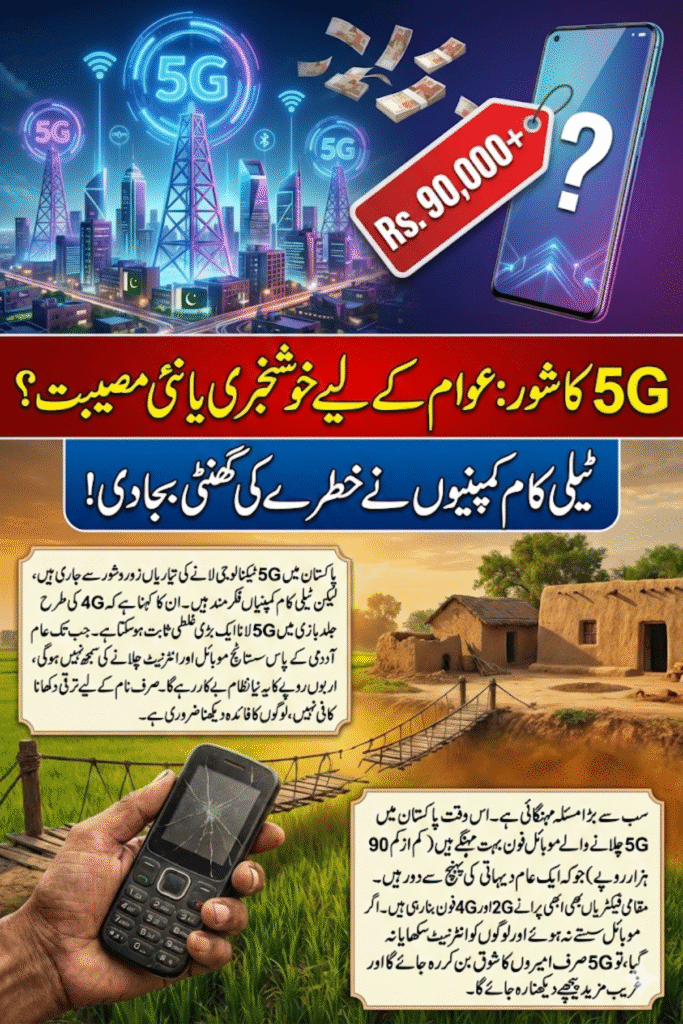
The 5G rollout in Pakistan, if pursued without addressing these gaps, may result in expensive networks with low usage. Industry leaders stress that upgrading existing infrastructure and improving access should come before investing heavily in new spectrum and technologies.
- One in four users still offline
- Limited broadband usage despite coverage
- Infrastructure upgrades still incomplete
You Can Also Read: Imam Masjid Wazifa Registration Form – Easy & Hassle-Free Online Application
Device Affordability and Consumer Readiness
One of the biggest challenges facing the 5G rollout in Pakistan is handset affordability. Industry estimates show that only about 2% of mobile users currently own a 5G-enabled device. Entry-level models are priced far above what most consumers can afford, effectively limiting access to a small segment of society.
With most mobile subscribers using prepaid services and lacking access to consumer credit, purchasing a 5G smartphone requires full upfront payment. This reality makes mass adoption unlikely and raises concerns about whether 5G networks will see meaningful usage in the near future.
- Entry-level 5G phones start around Rs. 90,000
- Premium models cost several hundred thousand rupees
- Prepaid users dominate the market
| Device Type | Approximate Price Range |
|---|---|
| Entry-level 5G phone | Rs. 90,000+ |
| High-end smartphone | Up to Rs. 700,000 |
| Average 4G smartphone | Significantly lower |
Local Manufacturing and Investment Challenges
Pakistan’s local mobile manufacturing sector has largely focused on affordable devices. Between 2019 and 2025, most assembled phones were basic 2G models, while smartphones were mainly low-cost 4G variants. Very few locally produced devices support 5G technology.
You Can Also Read: Imam Masjid Wazifa Apply Online – Official Portal for Easy Application
Adding 5G capability significantly increases production costs due to advanced components and longer retooling timelines. In a price-sensitive market, these higher costs discourage manufacturers from shifting quickly, even if policy incentives improve.
- Majority of locally assembled phones are 2G
- Limited domestic 5G production capacity
- Higher costs for advanced components
| Local Assembly Overview | Share |
|---|---|
| 2G feature phones | ~60% |
| 4G smartphones | Majority of smartphones |
| 5G devices | Minimal |
Policy Risks and the Digital Divide
Telecom operators warn that spectrum policies focused only on rollout deadlines could result in underused infrastructure. An expensive network with few users would strain financial resources and fail to deliver social or economic value. Aligning policy with consumer realities is seen as critical.
Beyond infrastructure, Pakistan faces a broader usability gap. Limited digital skills, lack of relevant content, and low trust in digital services already keep millions offline. Without fixing these issues, the 5G rollout in Pakistan may deepen inequality rather than promote inclusion.
- Risk of underutilized 5G networks
- Digital skills gap remains wide
- Urban-rural divide could increase
You Can Also Read: 8171 Ehsaas Program Registration 2026, Scan Your Current Standing Now
FAQs
What is the main concern about the 5G rollout in Pakistan?
The main concern is that high device costs and low consumer readiness could limit adoption and waste investment.
Why are 5G smartphones not widely used in Pakistan?
Most 5G devices are expensive, and users lack financing options, making them unaffordable for the majority.
How does local manufacturing affect 5G adoption?
Local manufacturers mainly produce 2G and 4G phones, with limited capacity to shift quickly to 5G devices.
What do telecom operators recommend instead of a rapid rollout?
They suggest lowering device taxes, enabling financing, improving digital skills, and upgrading existing networks first.
You Can Also Read: Rawalpindi School Timing Changes 2026: What Every Parent and Student Must Know