NEPRA Solar Net Metering Changes Explained
Pakistan’s solar energy sector has grown rapidly over the past few years as electricity prices increased and load shedding became a serious concern for households. Net metering played a major role in this growth by allowing homeowners to sell excess electricity back to the grid and reduce their monthly bills. Recently, NEPRA announced changes in solar net metering rules, creating confusion and concern among existing and future solar users.
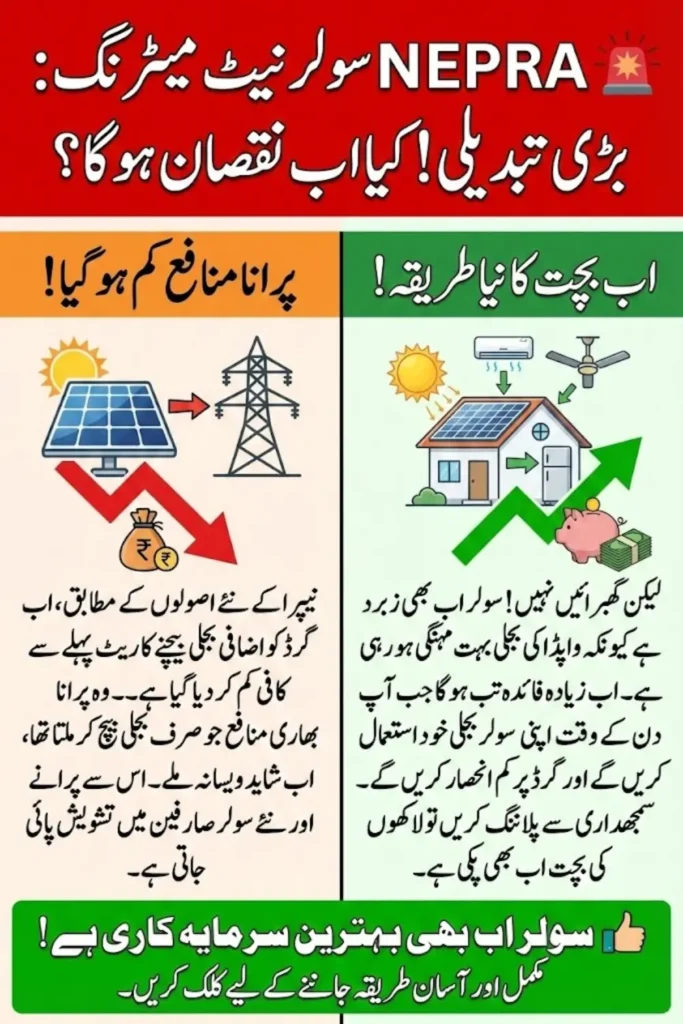
“Yeh article NEPRA ke solar net metering rules, nayi tabdeeliyon, unit rates aur gharailu users par honay walay asraat ko bilkul asaan aur detail andaaz mein samjhata hai taake aam aadmi bina confusion ke faisla kar sakay.”
These new NEPRA solar net metering changes aim to balance the power system, manage rising rooftop solar connections, and reduce financial pressure on distribution companies. However, for homeowners, the most important questions are about unit rates, savings, payback period, and whether solar is still a good investment. This detailed guide explains everything in simple language so you can clearly understand what has changed and how it affects you.
You Can Also Read:
What Is Solar Net Metering in Pakistan
Solar net metering is a billing mechanism that allows electricity consumers to generate power using solar panels and export extra units to the national grid. The exported units are adjusted against imported units in the monthly electricity bill, reducing overall costs for the consumer.
“Solar net metering Pakistan mein bijli bachanay ka aik moassar aur qabil-e-aitmad tareeqa hai jismein ghar apni solar bijli grid ko de kar mahana bill kam kar sakta hai.”
- Homeowners install a solar system connected to the grid
- Extra electricity produced during the day is sent to the grid
- Exported units are adjusted in the monthly billing
- Consumers pay only for net units used
- Helps reduce electricity bills significantly
Net metering allows homeowners to turn sunlight into financial savings.
You Can Also Read: https://nepra.org.pk/
Why NEPRA Introduced Changes in Net Metering Policy?
NEPRA introduced changes to address challenges faced by the power sector due to the rapid increase in rooftop solar installations. Distribution companies raised concerns about revenue losses, grid management issues, and cost burden shifting to non-solar users.
“NEPRA ne yeh tabdeeliyan is liye mutaarif karwai hain taake power system ko balance mein rakha ja sakay aur distribution companies par zyada financial bojh na paray.”
- Rapid growth of rooftop solar connections
- Financial pressure on power distribution companies
- Grid stability and load management concerns
- Unequal cost distribution among consumers
- Need for long term energy planning
The changes aim to protect grid stability and financial balance.
Key NEPRA Solar Net Metering Changes Explained
The revised net metering framework includes adjustments in export unit rates and billing structure. These changes mainly affect how much consumers earn for excess electricity they send to the grid.
“In NEPRA net metering tabdeeliyon ka seedha aur wazeh asar solar users ki kamai, monthly savings aur system ke return par parta hai.”
- Export units are now credited at a lower rate than before
- Imported electricity continues to be charged at regular tariff
- Separate accounting for import and export units
- Reduced financial benefit from surplus generation
- Focus on self-consumption instead of over-export
New rules reduce earnings from exported solar units.
New Solar Export Unit Rates Under NEPRA Rules
Ab solar units grid ko dene par pehle jaisa faida hasil nahi hota aur users ko zyada focus apni bijli khud istemal karne par karna hota hai.
Under the updated policy, the rate at which solar users sell electricity to the grid has been revised. Earlier, export units were adjusted at the same rate as import units, which provided maximum benefit to consumers.
- The export unit rate is lower than the retail electricity tariff
- The rate is closer to the generation cost instead of the consumer tariff
- The monthly bill shows separate import and export calculations
- Excess units no longer give a premium financial return
- Savings depend more on self-use of solar power
Export unit rates are reduced to reflect actual power costs.
Impact of Net Metering Changes on Homeowners
Homeowners with solar systems will notice changes in their monthly bills and overall savings. The level of impact depends on system size, usage pattern, and how much electricity is exported.
“Gharailu solar users ko nayi NEPRA policy ke baad apni bijli istemal ki aadaton aur solar system ki planning dobara karni hogi.”
- Monthly savings may decrease for high export users
- Homes with daytime usage face less impact
- Payback period for new systems may increase
- Existing users may retain partial benefits
- Proper system sizing becomes more important
Solar savings continue but with adjusted expectations.
You Can Also Read: BOP and Bank Al-Falah Machines Fixed, Money Now Available in Different Districts
Effect on Existing Solar Net Metering Consumers
Many existing solar users are worried about whether the new rules apply to them. NEPRA has indicated that protections may exist for approved connections, but financial returns could still change over time.
“Purane solar net metering users ke liye foran koi bara jhatka ya nuksaan nahi hai lekin mustaqbil mein faiday dheere dheere kam ho saktay hain.”
- Existing connections may keep earlier approval terms
- Billing structure may gradually shift
- Export unit value may be revised in the future
- Long term savings still remain positive
- No immediate disconnection or penalty
Existing users remain safe but returns may reduce slowly.
Impact on New Solar Installations in Pakistan
For new homeowners planning to install solar, the updated policy requires careful planning. The focus has shifted from earning through exports to maximizing personal usage.
“Naye solar system lagwanay walon ko NEPRA ke naye rules ko samajh kar aur apni zarurat ke mutabiq soch samajh kar faisla karna chahiye.”
- System size should match household consumption
- Over-sizing may reduce financial benefit
- Battery storage becomes more valuable
- Daytime electricity usage is encouraged
- Long-term planning is necessary
Smart planning is essential for new solar users.
You Can Also Read: BOP and Bank Al-Falah Machines Fixed
Is Solar Still Profitable After NEPRA Changes
Despite the reduced export rates, solar energy remains a cost-saving option due to rising electricity prices. However, profit margins are lower than before.
“Solar ab bhi faidemand aur behtar option hai lekin NEPRA net metering changes ke baad munafa pehle ke muqable mein kam ho gaya hai.”
- Electricity tariffs continue to increase
- Solar reduces dependence on grid power
- Savings mainly come from self-consumption
- Break even period may extend slightly
- Long-term benefits remain strong
Solar is still profitable with realistic expectations.
How Homeowners Can Maximize Savings Under New Rules?
Homeowners can adapt to the new net metering structure by changing usage habits and system design to protect their investment.
Samajhdari se bijli ka istemal, sahi system size aur din ke waqt zyada usage ke zariye nuksaan ko kaafi had tak kam kiya ja sakta hai.
- Use heavy appliances during daylight hours
- Install energy-efficient devices
- Avoid exporting excessive surplus electricity
- Consider battery backup solutions
- Regularly monitor system performance
Smart usage helps maintain strong solar savings.
You Can Also Read: Punjab Police Starts Using AI to Identify Vehicles With Duplicate Number Plates Know Details
Overall Conclusion
NEPRA solar net metering changes mark a significant shift in Pakistan’s renewable energy policy. The focus has moved from rewarding high exports to encouraging responsible self-consumption. While the changes reduce the extra financial advantage of selling surplus electricity, solar energy remains a reliable solution for reducing electricity bills and achieving energy independence.
“Yeh tabdeeliyan solar system ko zyada zimmedar, balanced aur long term planning ke liye behtar banati hain.”
For homeowners, understanding the new rules is the key to making informed decisions. With proper planning, realistic system sizing, and smart electricity usage, solar power can still deliver long-term financial and environmental benefits despite the revised net metering framework.
Frequently Asked Questions
“Logon ke aam aur aham sawalat ke asaan aur seedhay jawab yahan mukammal taur par diye gaye hain.”
Is net metering banned in Pakistan?
No, net metering is still allowed. Only the export unit rates and billing structure have changed.
Do NEPRA net metering changes apply to existing users?
Existing users are generally protected, but future billing adjustments may reduce export benefits.
Is solar still worth installing after new rules?
Yes, solar remains beneficial due to rising electricity prices, especially for homes with high daytime usage.
What is the biggest change in net metering policy?
The biggest change is the reduction in export unit rates compared to the previous rules.
How can I reduce the impact of new net metering rules?
You can reduce impact by using more electricity during the day and properly sizing your solar system.