
Khyber Pakhtunkhwa Free Solar Scheme for Merged Districts
The Khyber Pakhtunkhwa government has taken a major step toward clean and affordable energy by approving a solar scheme for deserving households in the merged districts. Under this initiative, 120,000 families will receive solar systems either free of cost or through easy monthly installments, reducing their dependence on expensive and unreliable electricity sources.
KP Free Solar Scheme 2026
Clean energy support for households in merged districts
Solar Capacity
Standard household system
- 2 kW solar system
- Suitable for basic home use
Beneficiaries
Households to receive solar
- 120,000 households
- Merged districts of KP
System Cost
Market-based pricing
- Rs 255,000 minimum
- Up to Rs 300,000
Project Budget
Government funded
- Total cost Rs 13 billion
- Provincial government support
Payment Options
Flexible support model
- Free (non-refundable)
- Installments option available
Implementation
Financial & technical oversight
- Bank of Khyber financing
- Technical support by PEDO
This scheme is designed to support remote and underserved areas where power shortages are common. By promoting solar energy, the provincial government aims to improve living standards, reduce energy poverty, and support long-term environmental sustainability.
- Focus on merged districts
- Support for low-income households
- Shift toward renewable energy
You Can Also Read: BISP 8171 Verification Closed: Complete Reasons, Updates & How to Resolve
Overview of the Khyber Pakhtunkhwa Free Solar Scheme
The Khyber Pakhtunkhwa Free Solar Scheme targets households in former tribal districts that face limited access to electricity. Each selected household will receive a complete 2 kW solar system to meet basic domestic energy needs.
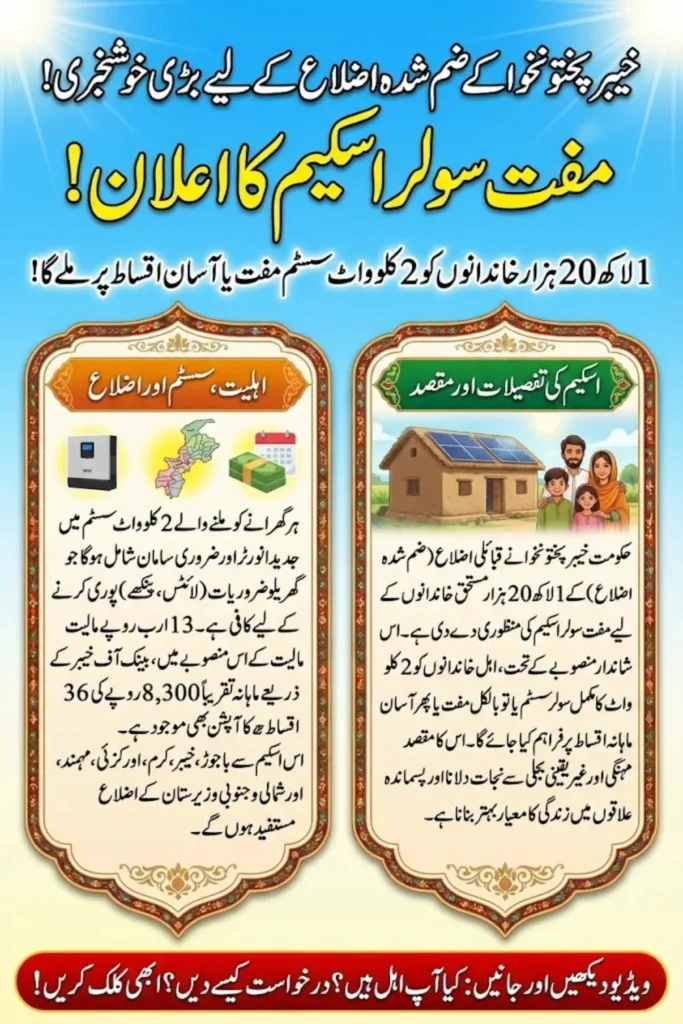
The program reflects the government’s broader strategy to promote renewable energy solutions while easing the financial burden on poor families. The scheme will be executed under a structured financial and technical framework to ensure transparency and efficiency.
- 120,000 households to benefit
- Solar systems are provided free or on installments
- Government-funded energy initiative
You Can Also Read: BISP 8171 Verification Not Completed? Step-by-Step Guide to Avoid Common Mistakes
2kW Solar System Specifications and Components
Each household under the scheme will be provided with a 2 kW solar system suitable for everyday household usage. The system includes essential components that allow families to generate and store electricity efficiently.
These solar systems are designed to power lights, fans, and small appliances, offering relief from frequent power outages. The inclusion of modern inverters ensures stable and usable electricity throughout the day.
- 2 kW solar capacity
- Inverter included
- Supporting equipment provided
You Can Also Read: 8171 Payment Wallet Not Working? Try This Updated Quick Fix for 2026
Cost of Solar Systems and Project Budget
The estimated cost of each solar system ranges between Rs 255,000 and Rs 300,000, depending on equipment and installation requirements. This pricing reflects current market rates for quality solar solutions.
The total cost of the project is estimated at Rs 13 billion, which will be funded by the government. This significant investment highlights the province’s commitment to renewable energy and social welfare.
- Per-unit cost up to Rs 300,000
- Total project cost Rs 13 billion
- Fully government-supported
You Can Also Read: 8171 Payment Location 2026 Check Online – Fast & Accurate Method
Solar Scheme Cost Breakdown
Solar Energy Support Program 2026
Affordable rooftop solar systems for households
System Capacity
Standard household solar setup
- 2 kW solar system
Minimum Cost
Lower price range
- Rs. 255,000 per system
Maximum Cost
Upper price limit
- Rs. 300,000 per system
Total Beneficiaries
Households to receive systems
- 120,000 households
Project Budget
Government funded initiative
- Total cost Rs. 13 billion
Coverage Scope
Large-scale household coverage
- Nationwide household support
Refundable and Non-Refundable Payment Options
The KP government has proposed two financial options for beneficiaries under the solar scheme. In the refundable option, beneficiaries will repay part of the system cost through manageable monthly installments.
Under this option, users will pay approximately Rs 8,300 per month for 36 months. In contrast, the non-refundable option allows eligible households to receive the solar system completely free of cost.
- Refundable installment option available
- Non-refundable free option offered
- Flexible support for beneficiaries
You Can Also Read: BISP 8171 NADRA Biometric Payment Ongoing Update 2026, Check Qualification Now
Role of Bank of Khyber in Project Implementation
The solar project will be implemented through the financial model of the Bank of Khyber. The bank will be responsible for managing financing arrangements and selecting approved vendors for the project.
This structured approach ensures financial discipline and quality control. The involvement of a provincial bank adds credibility and transparency to the overall implementation process.
- Financial model by Bank of Khyber
- Vendor selection responsibility
- Installment management
You Can Also Read: 8171 Payment Location 2026: Find and Track Your Nearest Ehsaas Cash Center Online Easily
Technical Support by PEDO
Technical support for the solar scheme will be provided by the Pakhtunkhwa Energy Development Organization. PEDO will ensure that installations meet required standards and systems operate efficiently.
Their role includes technical oversight, system validation, and coordination with vendors. This ensures long-term functionality and reliability of the solar systems.
- Technical supervision by PEDO
- Quality assurance measures
- Support during installation
You Can Also Read: Fix 8171 Payment Wallet Technical Glitch: Best Troubleshooting Tips
Districts Covered Under the Solar Scheme
The solar scheme will be implemented across all merged districts of Khyber Pakhtunkhwa. These areas have historically faced infrastructure challenges and energy shortages.
Districts included in the project are Bajaur, Khyber, Kurram, Orakzai, Mohmand, North Waziristan, and South Waziristan. The initiative aims to bring uniform development to these regions.
- Bajaur and Khyber
- Kurram and Orakzai
- Mohmand and Waziristan districts
You Can Also Read: BISP Wallet SIM 8171 Login & Verification: Updated Guide for Every User to Know
Beneficiary Selection Process
The selection of beneficiaries will be carried out by the Khyber Pakhtunkhwa government. Priority will be given to deserving and low-income households based on defined eligibility criteria.
This centralized selection process aims to ensure fairness and transparency. Local administration data may be used to identify families most in need of energy support.
- KP government selects beneficiaries
- Focus on deserving households
- Transparent selection approach
You Can Also Read: 8171 Payment Missing in Wallet? Complete Guide to Fix It Fast in Your Digital Wallet
Federal Cabinet Review and Oversight
The Prime Minister has summoned a meeting of the federal cabinet to review matters related to governance and development projects. Large-scale initiatives like this solar scheme often require federal-level awareness and coordination.
Such oversight ensures alignment between provincial and federal development goals. It also strengthens accountability for public spending on welfare projects.
- Federal cabinet meeting scheduled
- Oversight of major initiatives
- Coordination between governments
You Can Also Read: 9999 Ramzan Relief Package 2026: Eligibility, Registration Process
Expected Impact of the Solar Scheme
The solar scheme is expected to significantly improve energy access in merged districts. Families will benefit from reduced electricity expenses and improved quality of life.
In the long term, the project may encourage wider adoption of renewable energy solutions across the province. It also sets a model for similar initiatives in other regions.
- Improved household energy access
- Reduced dependence on grid electricity
- Environmental and economic benefits
You Can Also Read: 9999 Ramzan Relief Package 2026: Who Can Apply, Amount Details, and Payment Process
Conclusion
The Khyber Pakhtunkhwa Free Solar Scheme for merged districts represents a meaningful investment in renewable energy and social development. By providing 2 kW solar systems to 120,000 households, the government aims to address energy shortages while supporting low-income families.
With structured financing through the Bank of Khyber and technical support from PEDO, the project promises transparency and efficiency. This initiative has the potential to transform daily life in remote districts and promote sustainable energy use across the province.
You Can Also Read: Honda Civic 2026 Price in Pakistan, Specs, Features & Booking Details
FAQs
Who is eligible for the KP Free Solar Scheme?
Deserving households in the merged districts selected by the KP government are eligible.
How much capacity does each solar system have?
Each household will receive a 2 kW solar system with an inverter and required equipment.
Is the solar system completely free?
Yes, under the non-refundable option the system is free, while a refundable option offers installments.
What is the monthly installment under the refundable option?
Beneficiaries will pay around Rs 8,300 per month for 36 months.
Which districts are included in the solar scheme?
Bajaur, Khyber, Kurram, Orakzai, Mohmand, North Waziristan, and South Waziristan are included.
You Can Also Read: BISP 8171 to Start Digital Wallet Payments for 10 Million Families from March 2026